
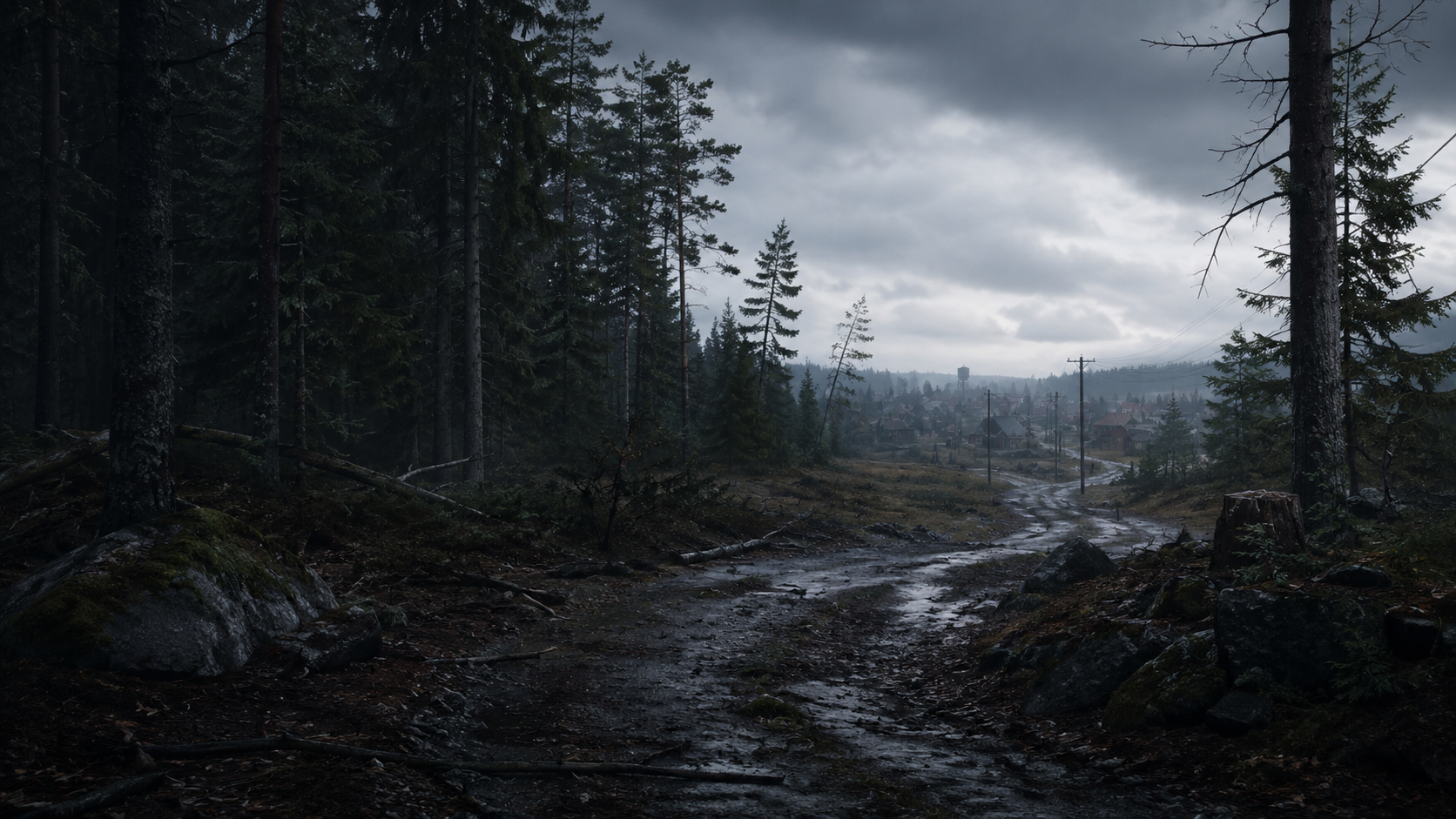
Rönnfors Takes Root
There is a strange moment in game development when a place stops being a collection of notes and starts feeling as though it might actually exist.
For Rönnfors, that moment involved trees.
A lot of trees.
Until recently, the town existed through written descriptions, concept images and maps viewed from high above. I knew what Rönnfors was supposed to feel like. I knew who lived there, what had happened to it and which parts of the town would matter when the storm arrived.
But knowing a place and building it are two very different things.
Now, the first small part of Rönnfors has begun to take shape inside Unreal Engine.
From a name to a town
Before I could start placing buildings, I needed to understand how Rönnfors fit together.
Where does the river run? Which roads connect the different parts of town? Where would people live, work and gather? Which routes become important if fallen trees or damaged bridges suddenly cut one district off from another?
These are not only visual decisions. The shape of the town will eventually affect how players move through it, which places they can reach and what happens when part of its infrastructure fails.
I began with an overview of Rönnfors and gradually divided it into nine distinct districts:
- Town Centre
- Riverside
- Residential Heights
- Main Bridge
- Emergency Depot
- Waterworks
- Old Hydro
- Sawmill
- Comms Ridge
Each district has now received its own detailed top-down plan. Together, they provide the foundation for the roads, buildings, landmarks and surrounding landscape that will eventually form the complete town.
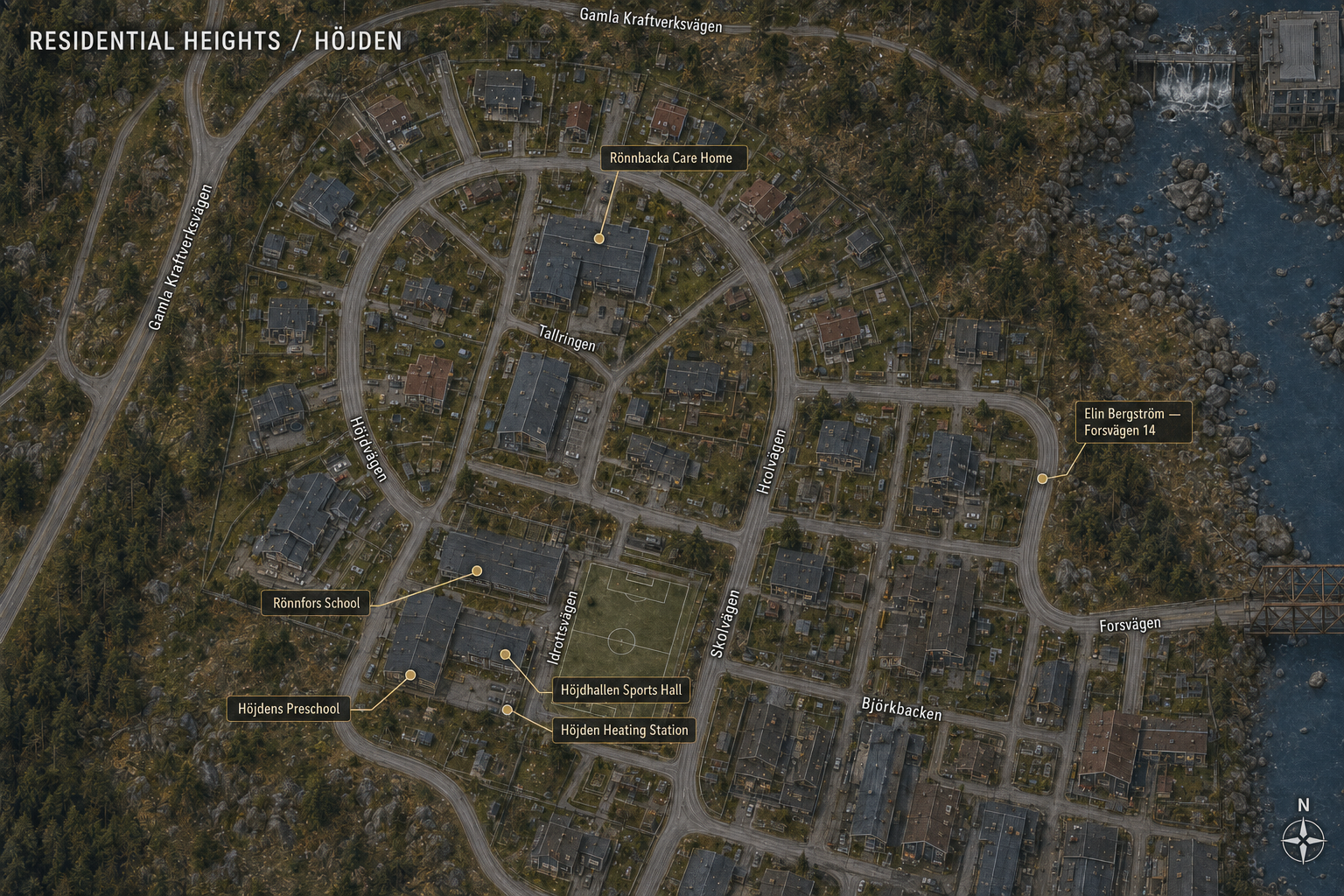
The maps will continue to change as development progresses. Something that looks sensible from above may feel completely wrong when experienced at ground level. Distances may need adjusting. Roads may move. Buildings may disappear or find a better home.
That is exactly why these plans exist: they give me somewhere to begin without pretending that every decision is already final.
Stepping into Unreal Engine
Moving from maps into Unreal Engine was the next major step—and also the point where everything became much more real.
I am learning the engine while building the game, so even apparently simple tasks can involve a lot of experimentation. The first goal was not to construct the town centre or start decorating houses. It was to establish the landscape, understand the scale and create the systems that will eventually allow the world around Rönnfors to grow.
That included setting up World Partition, which will help manage the larger game world, and experimenting with Unreal’s Procedural Content Generation tools.
Or, in less technical language: I wanted to see whether I could make a forest.
The first trees
My first attempt was technically successful.
There were trees.
Just not very many of them.
I entered the level to see how everything looked beside the player character and discovered that what had seemed reasonable from a distance felt remarkably empty at ground level. Ten trees may satisfy the definition of “trees,” but they do not make a convincing Scandinavian forest.
So I adjusted the density and tried again.
This time, the empty landscape became a small forest.
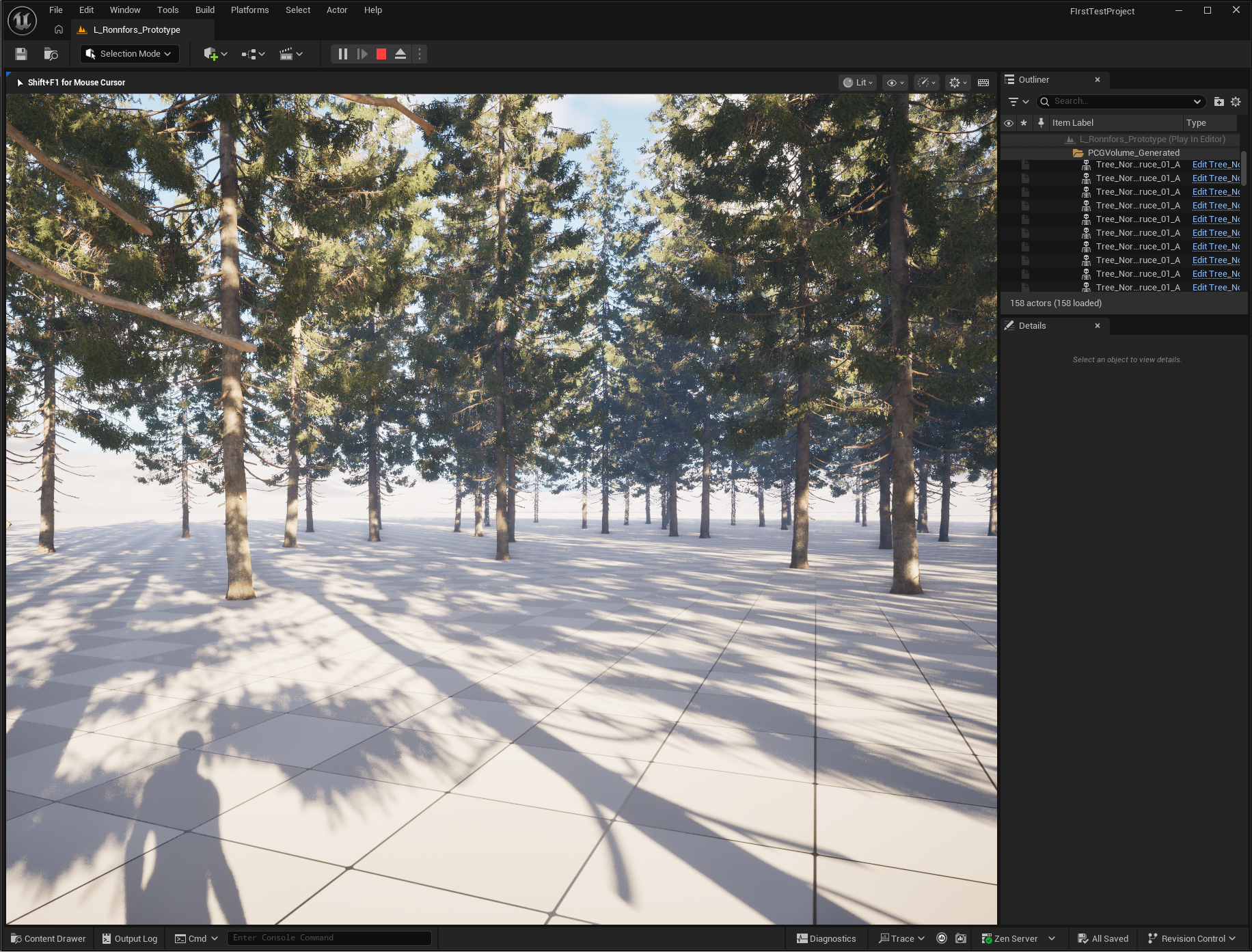
It is still only a test. These are not necessarily the final trees, the landscape is far from finished and there is an enormous amount of work ahead. But standing beside them inside the level changed something. For the first time, I was not only looking at a plan for Rönnfors.
I was standing in it.
That may seem like a very small milestone—and technically, it is. But early development is built from moments like this. A system works. The scale begins to make sense. Something that existed only in your imagination appears in front of you, even if it is still rough around the edges.
And then you build the next piece.
What comes next
The immediate work is still focused on the foundations: shaping the terrain, testing scale, developing the road network and finding the right balance between forests, open land and the built-up districts.
The town will not appear all at once. It will grow road by road, district by district and building by building. Some parts will work immediately. Others will probably be rebuilt several times before they feel right.
I want to share that process honestly—not only the polished images and successful milestones, but also the experiments, mistakes and unexpected little victories along the way.
Rönnfors is not a playable town yet. It does not have finished streets, working infrastructure or residents going about their lives.
But it is no longer only a name on a map.
It has a landscape. It has a sense of scale.
And now, it has its first forest.
The lights are still off—but at least there are trees outside the windows.— Linda Karlsson, Founder & Creative Director